I built myself a daily newspaper. Here’s the lowdown on how to do that yourself and how it can teach teams about building AI agents.
The newspaper is the least interesting part of this story, so let’s get that out of the way.
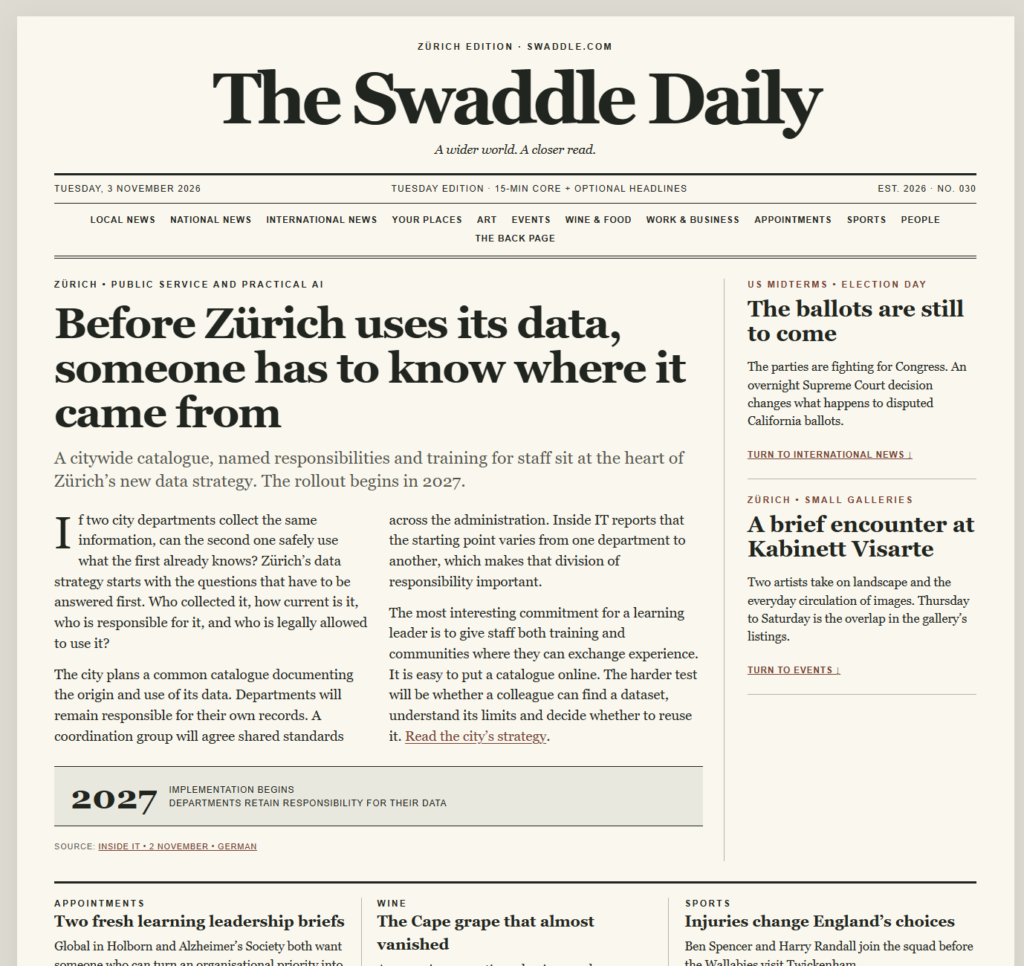
Each morning an AI agent reads a few hundred sources and then, using a set of rules about what matters to me, lays out a twelve-desk paper: Zürich, Switzerland and the UK, the world, art, events, wine, work and business, learning-leadership & AI adoption vacancies, rugby and F1, people, and a back page with a puzzle. It has an archive and a print button. Check out the latest edition from this morning.
Building this has been kind of a hobby. An experiment in agentic AI and progressive improvement. Now I think every learning leader should try the same: create an agent, define what good looks like, and keep correcting the agent until you’re happy with the outputs.
These are agentic AI skills that every manager who has an AI assistant should build.
The problem was never finding things
I could no longer keep up, and I suspect you can’t either. Research papers, vendor launches, model releases, consultancy reports, regulatory guidance, and a few hundred LinkedIn opinions before breakfast. Some of it matters. Most of it doesn’t.
Over the years I’ve accumulated sources. Newsletters, alerts, bookmarked journals, saved reports I occasionally remembered to open. That is not an information system. It’s an overload of things I don’t have time to read. How do I find what really matters to me in the deluge.
Deciding what deserves attention is a problem. AI enables a new approach. Instead of subscribing to more, I can ask a system to look across everything, filter by my interests, apply my standards, and prioritise a handful of things for each topic that might interest me today.
Summarising is cheap. Filtering is the job.
I don’t want AI to give me 40 links and call it a briefing. The value is in judgement based on my personal criteria: what’s significant, what’s credible, what’s new, what’s from the places I’m interested in, and what does this mean for me.
Here’s three examples from the archive that show what that looks like when it works.
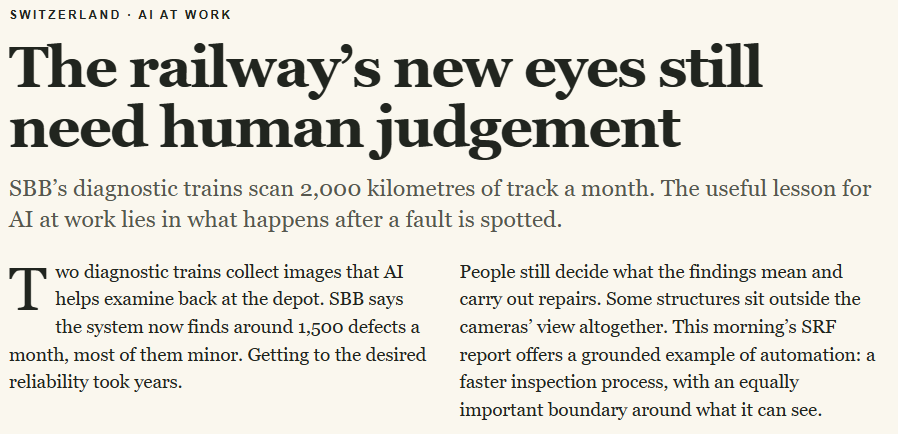
On 21 September, SBB announced how its diagnostic trains use AI to scan 2,000 km of track a month and find about 1,500 defects. A feed would have given me “Swiss railway adopts AI”.
/
My paper led with what happens after a fault is spotted: people still decide what the findings mean, and some structures sit outside the cameras’ view altogether. In the local desk it added the question I would have asked: how do operators learn the system’s blind spots? On the back page it turned that into a design exercise. Give participants evidence the tool can see and evidence it cannot, make them mark the boundary before accepting its recommendation, then reveal a fact from outside its view and watch who revises.
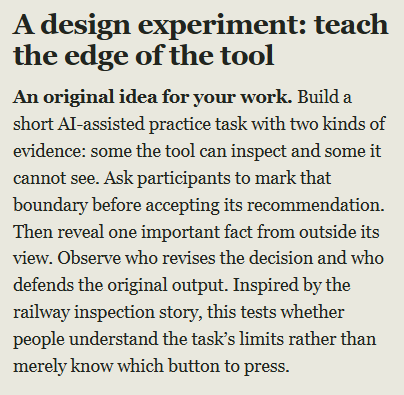
A story that interests me, as it’s about the application of AI, in a geography that impacts me, with a personal angle on the summary, and re-used at the end of the newspaper to spark learning and development ideas based on this. That’s the sort of hyper-personalisation AI can deliver.
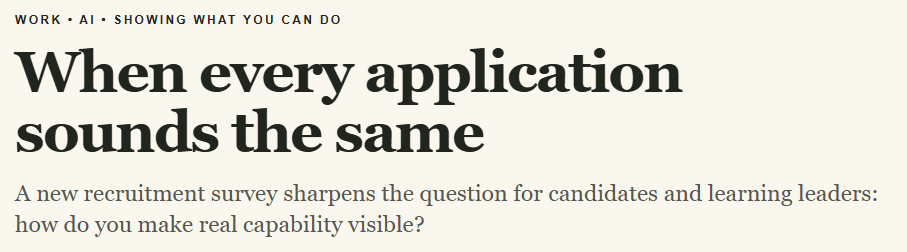
On 14 October the Institute of Student Employers reported that 92% of UK graduate recruiters had encountered or suspected AI misuse in applications. The paper printed the number, then immediately noted that this measures employers’ experience, not the proportion of candidates cheating. It then turned the story towards the question that matters for a learning leader: when every application sounds the same, how do you make real capability visible?
So this time a story targeting two areas I care about: the recruitment experience and ethical use of AI. The way that my AI agent finds, quality checks, and filters stories like these means I get a feed where each ‘desk’ contains relevant stories to keep me interested and informed.

This morning it found a survey showing how workers under 30 have greater unease about AI use than over 50s. Then it further anchors that to my interests with a follow-up question about where junior colleagues get to practise judgement calls and learn from experience when AI does the basic work.
These stories (a railway, a recruitment survey, a union poll) didn’t come from L&D sources, they came from a wider pool of sources. The connections I find most useful straddle categories. An L&D newsletter that only reads L&D would miss them.
The breadth and practicality stimulates me. A McLaren heritage piece about digitising Ayrton Senna’s 1993 notes becomes a knowledge-management case. The City of Zürich’s new data strategy becomes an idea for a learning activity about whether colleagues can find a dataset and judge its limits.
My personalised briefing deliberately looks for the connections. That’s why it beats another generic feed. This is my news, on my topics, just for me.
What I was really building was an editorial policy
The first editions were generic: too many product announcements, too many loosely relevant articles, and old research presented as new because somebody had mentioned it that week. The judgement wasn’t there at the start.
So, I corrected the AI, progressively nudging it in the the right direction. Give more weight to original research. Use the first public publication date, not the date something was indexed or discussed. Downrank minor product news, generic opinion and thinly disguised marketing. Separate a claim from a finding. Say when a figure is an estimate, a proposal or an opinion rather than a fact.
Six weeks on and now the agent customises a daily paper without being asked. A UBS downgrade of Roche carries the note “this is a valuation opinion”. A White House plan to vet NIH grants is “a reported proposal, not a new operating rule”. The editorial habits didn’t come from one clever prompt. They came from weeks of telling the system, item by item, what good looked like, why some things fell short, and suggesting improvements.
I think it’s a useful lesson. A personalised AI system doesn’t work because you write the perfect specification once, but it gets there gradually as you tune it and provide feedback. What you end up with is not a prompt, but rather an editorial policy for your own attention, which is a thing most of us have never had before.
Why should AI and learning leaders care?
Three reasons, in rising order of discomfort.
Some people are already doing this, badly. Sime not at all. Knowledge workers are drowning in information the same way I was. The few who have worked out how to specify what they want from an AI agent, judge what comes back, and tighten the rules, are quietly pulling ahead.
We need to build the core skills of working with agents, not just prompt-writing. Almost nobody is teaching it and most AI literacy programmes don’t contain it. Setting up a personalised, team, or theme newsletter like this can teach the skill in a practical way and build useful artefacts at the same time.
The specification is the capability. By writing instructions like “use the first publication date, not the date it was discussed”, I’m moving standards out of my head and into rules agents can apply consistently. Organisations are full of standards like this, and many live in the heads of a few experienced people. The firms that can write them down and have AI apply them will have a different relationship with their own expertise from the firms that cannot. That is a learning and development question before it is a technology one, and it is sitting unowned in most organisations.
Curation is a learning intervention. The paper’s value is not that it tells me things. It decides what I should think about and frames each item as a around my practice and interests.
Imagine a weekly edition for your leadership cohort, built on your organisation’s own priorities, that puts questions like the SBB blind-spot in front of managers with the original source linked. That can get people thinking and automate a level of curation and curiosity stirring. It’s cheaper than a course, closer to the work, and can drive discussions and continuous skill building.
If you want to build a personalised newsletter
Start much more simply than I did.
You get the value by asking ChatGPT (yes, that’s what I use but other platforms will work too) to produce the briefing each morning. The website archive is for people who enjoy building websites, so you can skip that bit if you like or leave it for later.
- Decide what it is for. “News about L&D” is too broad. “Developments that could materially change how we design, deliver or evaluate workplace learning” is a purpose.
- Name the areas. Workplace learning, learning science, AI adoption, organisational change, leadership, your industry, your geography. If you work in Europe, regulation belongs on the list.
- Define “new”. First public publication or online-first date. Later indexing or discussion does not count. This single rule fixed most of my early problems.
- Say what you value and what you will downrank. Original research, credible analysis, evidence from real organisations. Not minor product news, recycled opinion or marketing.
- Say what each story must do. What happened, enough context, why it matters, the implication for L&D, a link to the original.
- Cap it ruthlessly. Five to eight items, readable in minutes. AI is much better at adding than subtracting. If you ask for comprehensive, you will get it and you will not read it, so filter down.
- Schedule it. Every weekday morning at a time you will open it. I get it at 8am to start my working day.
- Treat the first month as editing. Tell it when something is generic, when a source is weak, when a story is exactly right. Tighten the date rule if old material keeps appearing. Cut the count if you stop reading to the end. Ask for what you want and tweak, tweak, tweak.
Once the content is reliably good you can elaborate: a weekly research edition, a section for your industry, a version for a team or a leadership cohort, an archive. Don’t start there, but get there in the end.
The reversal
We have spent years adapting ourselves to other people’s information systems: their newsletters, their feeds, their websites, their idea of what we should know. Let’s reverse that.
We define the information we want, the standard we hold it to, and the attention we are prepared to give it. Then the system does the searching and the filtering.
My newspaper is a small, personal version of that reversal. The larger version is what happens when an organisation does it for its managers, its experts and its leaders, and has to write down, for the first time, what it thinks good editorial judgement looks like.
That is the question spent my time working on. If it is one you are sitting with, I would like to hear how you are approaching it. If you’re interested in exploring building agent-steering capabilities for your organisation then please let me know.